
Lora P2P vs LoRaWAN
Comparison of LoRa P2P and LoRaWAN for long range wireless communication.
This article analyzes the technological differences, implementation strategies, and industrial implications of LoRa in Peer-to-Peer (P2P) mode versus the LoRaWAN protocol stack, focusing on the Semtech SX1262 transceiver and the The Things Network (TTN) ecosystem.
1. The Hardware Foundation: Semtech SX1262
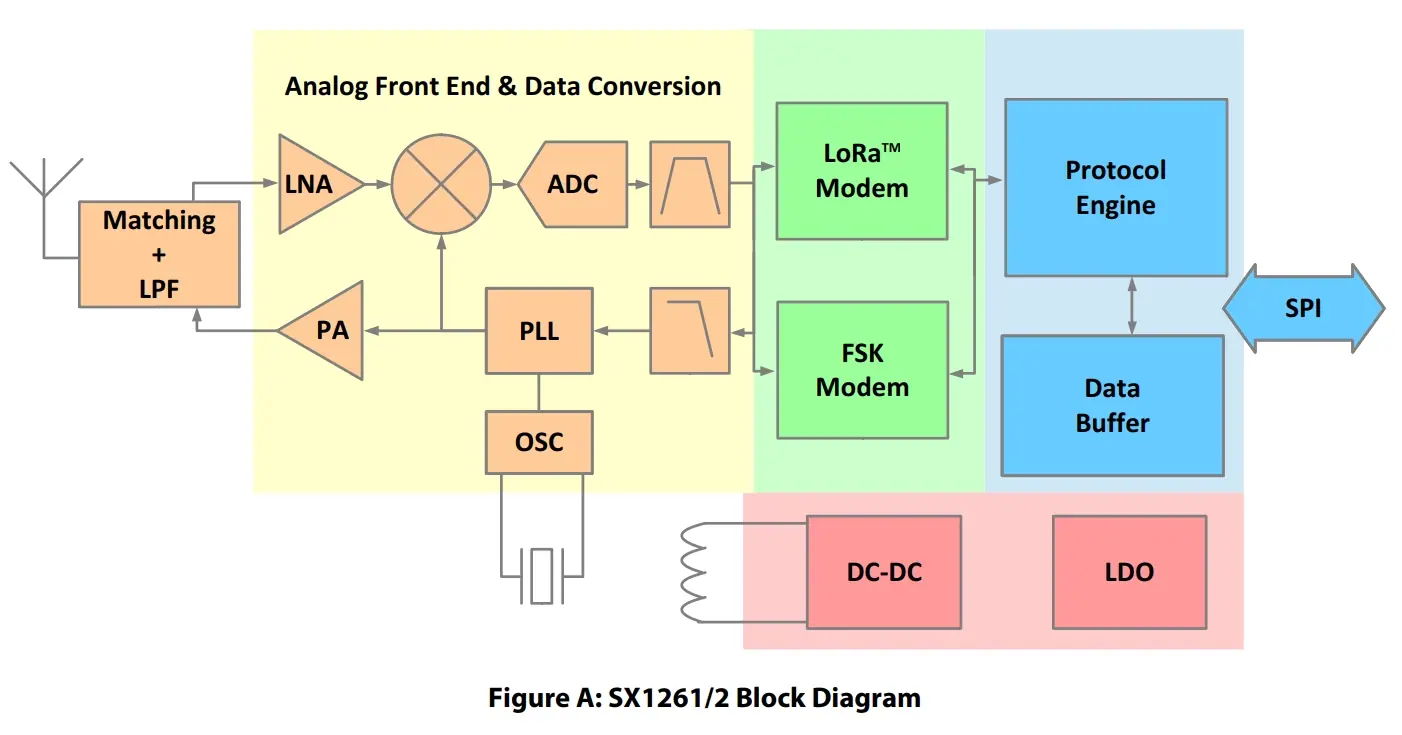
The SX1262 represents the current state-of-the-art in LoRa transceiver technology. Compared to its predecessor (SX127x), it offers significant enhancements crucial for both P2P and LoRaWAN:
- Improved Link Budget: Up to +22 dBm transmit power and sensitivity down to -148 dBm.
- Power Efficiency: Integrated high-efficiency DC-DC converter reduces current consumption in receive mode by over 50% (dropping to ~4.6 mA).
- Enhanced Radio Performance: Better blocking immunity and a wider frequency range (150 MHz to 960 MHz).
2. LoRa P2P (Point-to-Point)
In P2P mode, two or more SX1262 modules communicate directly without a gateway or network server. The developer has full control over the MAC layer.
Technical Characteristics
- Custom Frame Structure: No standardized overhead. Packets can be kept minimal to save airtime.
- Timing Control: Synchronization and transmission intervals are managed manually (e.g., via Polling or Time-Slotted Channel Hopping).
- Frequency Management: The developer is responsible for implementing regulatory requirements like Duty Cycle or Listen Before Talk (LBT).
Advantages
- Ultra-Low Latency: No routing through gateways or cloud servers means minimal Round-Trip Time (RTT).
- Autonomy: No dependency on internet connectivity or third-party infrastructure.
- Lower Energy Overhead: Since there is no periodic polling of network servers or complex join procedures, the protocol overhead is nearly zero.
Disadvantages
- Scalability Issues: As the number of nodes increases, collisions rise exponentially without a coordinated MAC layer.
- Security Responsibility: Encryption (e.g., AES-128) must be implemented manually in the firmware.
- No Standard Roaming: Communication is restricted to the specific local group of nodes.
3. LoRaWAN with The Things Network (TTN)
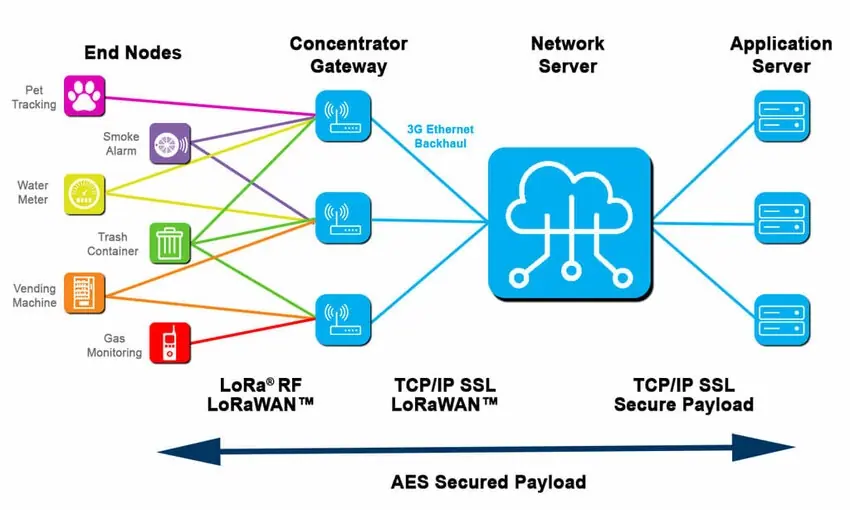
LoRaWAN is a standardized networking protocol built on top of LoRa physical layer. TTN acts as a global, open-source Network Server (LNS).
Technical Characteristics
- Star-of-Stars Topology: End-nodes transmit to gateways, which forward packets to the network server (TTN).
- Adaptive Data Rate (ADR): The LNS dynamically optimizes the Spreading Factor (SF) and transmit power for each node to maximize battery life and network capacity.
- Security: Standardized two-layer AES-128 encryption. It uses
NwkSKeyfor network integrity (split into three separate session keys in LoRaWAN 1.1 for higher security) andAppSKeyfor end-to-end data privacy.
Practical Setup: TTN Device Provisioning
When deploying an SX1262 end-device on TTN, the firmware must strictly align with regional network parameters. The screenshot below shows the device overview in the TTN Console for a registered device (e.g., xiao-sx1262).
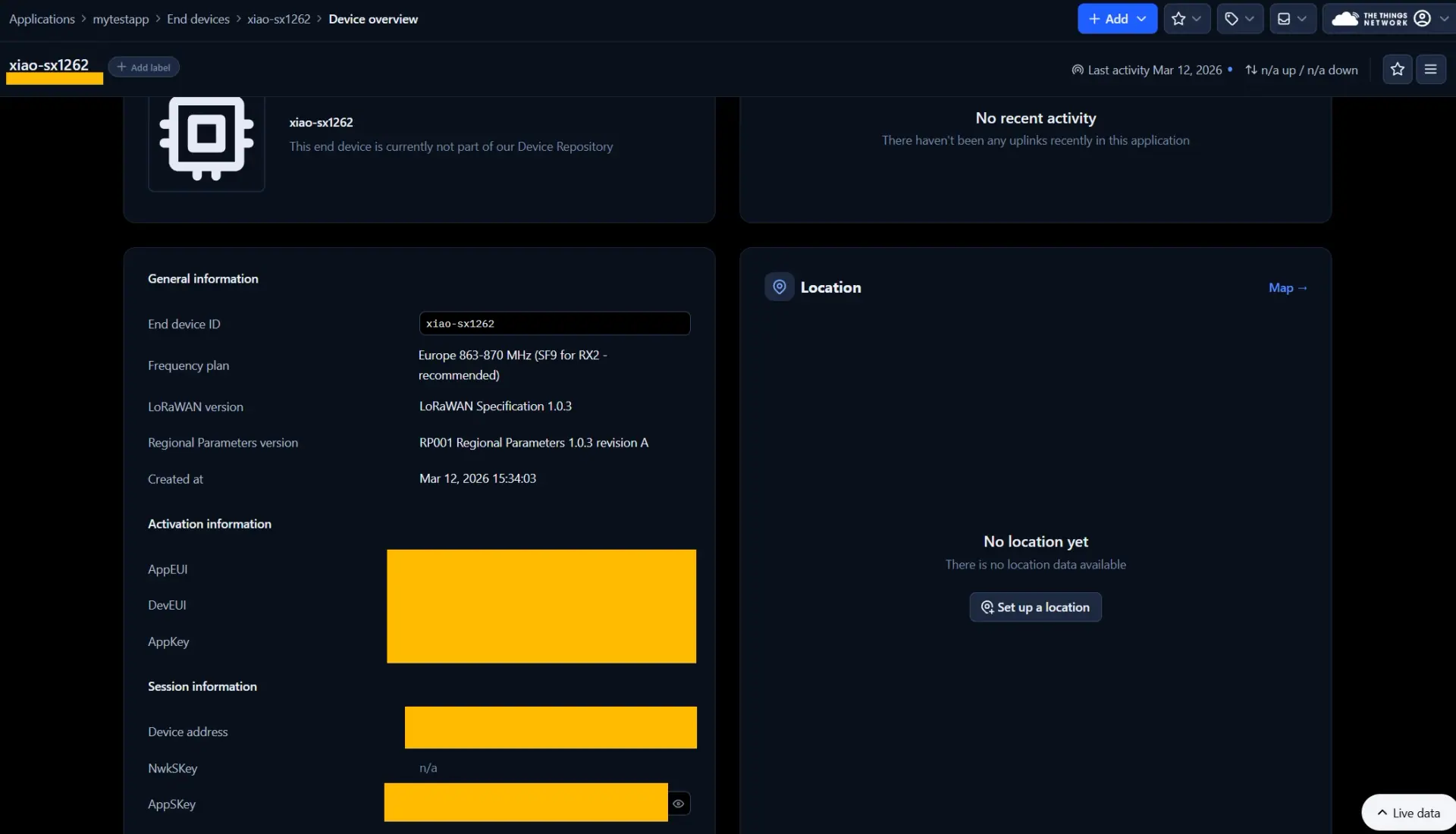
A typical configuration profile for a European deployment includes:
- Frequency Plan: Europe 863-870 MHz (Note: Using SF9 for the RX2 receive window is highly recommended by TTN to ensure reliable downlinks).
- LoRaWAN Version: LoRaWAN Specification 1.0.3 (A highly stable and widely adopted MAC version).
- Regional Parameters Version: RP001 Regional Parameters 1.0.3 revision A.
Understanding the Console Parameters:
The console clearly separates public metadata from highly confidential activation credentials. While local aliases like the End device ID are public, the DevEUI, AppEUI, and AppKey must remain secret, as they act as the root credentials for the network.
Furthermore, because this device utilizes the recommended OTAA (Over-The-Air Activation), the Network Session Key (NwkSKey) is initially listed as n/a. This key is dynamically generated in the backend only after the device completes its first successful join request, ensuring maximum security.
For the best connection, check the TTN Mapper to see if there are LoRaWAN gateways nearby.
Advantages
- Interoperability: Sensors from different manufacturers work seamlessly in the same network.
- Global Infrastructure: Leverage the existing community-driven gateway coverage provided by TTN.
- Centralized Management: OTAA allows for easy deployment and management of large-scale fleets.
- Collision Mitigation: LoRaWAN uses an ALOHA-based MAC layer. While it cannot completely avoid collisions, the LNS mitigates them by leveraging gateway diversity, orthogonal Spreading Factors (via ADR), and pseudo-random channel selection.
Disadvantages
- Protocol Overhead: Each packet contains headers that increase airtime (critical for very small payloads).
- Downlink Latency: In Class A (most common), downlinks are only possible after an uplink, making real-time actuator control difficult.
- External Dependency: A loss of internet connection at the gateway or a downtime of the TTN backend interrupts the data flow.
4. Engineering Comparison Table
| Feature | LoRa P2P (SX1262) | LoRaWAN (TTN Stack) |
|---|---|---|
| Topology | Peer-to-Peer / Mesh (Proprietary) | Star-of-Stars |
| Security | Manual Implementation | AES-128 (Standardized) |
| Scalability | Low (Collision risk) | High (ADR & Mitigation) |
| Configuration | Static (Freq/SF/BW) | Dynamic via ADR |
| Infrastructure | None required | Gateway + Network Server |
| Latency | Very Low | Moderate to High (Class A) |
5. Industrial Use-Case Recommendations
Choose LoRa P2P when:
- Real-time responsiveness is critical (e.g., remote control of machinery).
- Operating in isolated environments without internet access (e.g., underground mining).
- Building a simple, low-node-count system where setup speed is more important than management features.
Choose LoRaWAN/TTN when:
- Building scalable IIoT infrastructures (e.g., Smart Factory, Smart City).
- Battery life optimization for hundreds of sensors is required via ADR.
- Data security and standards compliance are mandatory for industrial audits.
Conclusion
The SX1262 is a versatile powerhouse capable of both modes. While P2P offers unmatched simplicity and speed for local tasks, LoRaWAN via TTN is the industry standard for robust, secure, and wide-area sensor networks. For most professional IIoT applications, the standardized management and scalability of LoRaWAN outweigh the overhead costs.
Michael Neumüller
Embedded & hardware engineer · Bern